
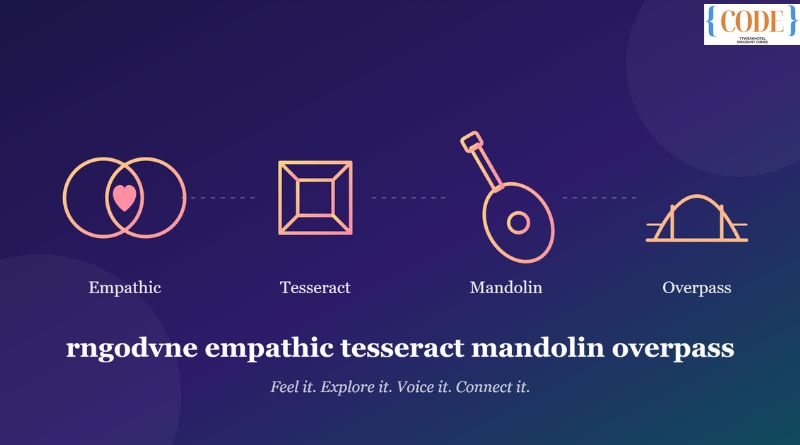
Understanding the Idea Behind rngodvne empathic tesseract mandolin overpass
rngodvne empathic tesseract mandolin overpass is an unusual phrase, and at first glance it looks like four unrelated worlds colliding. Empathy belongs to human emotion, a tesseract belongs to geometry, a mandolin belongs to music, and an overpass belongs to city engineering. Yet when you place them side by side, they form a surprisingly useful way of thinking about how people connect, how ideas travel, and how we build bridges between things that seem far apart. The term works as a creative framework: each word represents one layer of understanding, and together they describe a journey from feeling to structure, from structure to expression, and from expression to real-world connection.
The Empathic Side: Feeling Before Thinking
Why empathy comes first
Empathy is the starting point of the whole concept. Before any idea can be shared in a meaningful way, the person sharing it must understand who is listening. In writing, teaching, and design, this means putting yourself in the reader’s position and asking what they already know, what worries them, and what they hope to find. The empathic layer of rngodvne empathic tesseract mandolin overpass reminds us that information alone is cold. A fact becomes valuable only when it reaches a real person in a form that person can absorb. Writers who skip this step often produce text that is technically correct but emotionally distant, and readers can feel that distance within a few lines.
The Tesseract Layer: Seeing Beyond One Dimension
Thinking in more than one direction
A tesseract is the four-dimensional cousin of a cube, and nobody can truly picture it, but we can still study its shadows and projections. In the context of this framework, the tesseract stands for complexity. Real problems rarely have a single side. A personal decision may involve money, family, time, and emotion all at once, and each factor changes how the others behave. The tesseract part of the idea teaches us to hold several perspectives together instead of forcing a simple answer too early. When you explore a subject through the lens of rngodvne empathic tesseract mandolin overpass, you learn to accept that clarity sometimes comes from rotating a problem and viewing it from a new angle, not from simplifying it.
The Mandolin Layer: Giving Ideas a Voice
Expression and rhythm
The mandolin brings sound and emotion into the picture. It is a small instrument with a bright, trembling tone, and it can carry a melody with great delicacy. Here it represents expression, the moment when understanding becomes something others can hear, read, or feel. Good communication has rhythm. Sentences rise and fall, pauses give weight to important points, and tone tells the audience how to interpret the message. A thoughtful writer or speaker is a bit like a mandolin player, choosing each note carefully so that the whole piece feels natural and alive instead of mechanical.
The Overpass Layer: Connecting People and Ideas
Building a bridge that actually works
An overpass lifts one road above another so that traffic can flow without collision. As a symbol, it stands for connection and smooth movement between different paths. Every strong article, lesson, or conversation acts as an overpass, carrying the reader from confusion to understanding without forcing them to stop or backtrack. The final stage of rngodvne empathic tesseract mandolin overpass is about delivery: structuring information so that it is easy to follow, logically ordered, and open to people from different backgrounds. A well-built overpass is rarely noticed because it simply works, and the best communication shares that same quiet reliability.
Final Thoughts
Taken together, the four parts of this phrase describe a complete process. You begin by listening with empathy, you explore the many dimensions of a subject, you express it with care and rhythm, and you connect it to others through clear structure. Whether you are writing content, studying psychology, or simply trying to explain something to a friend, this approach keeps both the human and the idea in view. That is why rngodvne empathic tesseract mandolin overpass, strange as it sounds, can serve as a memorable reminder that good understanding is built, felt, played, and shared all at once.
read also this: An Introduction to a Lighter Way of Working