
If you’ve come across 1164.68.127.15 while checking your router settings, browsing network logs, or troubleshooting a connection issue, you’re probably wondering exactly what it is and why it showed up on your screen. This string looks like a typical IP address at first glance, but a closer look reveals something important that many users miss. In this article, we’ll break down what 1164.68.127.15 actually represents, why it might appear in your system, and what steps you can take if you run into it.
Understanding the Structure of 1164.68.127.15
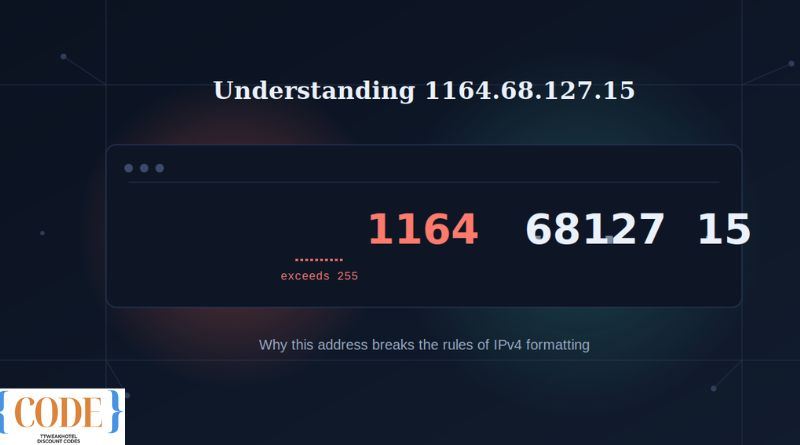
Every standard IPv4 address is made up of four sections, called octets, separated by periods. Each of these octets can only hold a value between 0 and 255. When you examine 1164.68.127.15 closely, the very first segment, 1164, immediately stands out as a problem. Since it exceeds the maximum allowed value of 255, this address does not follow the proper IPv4 format. This means that 1164.68.127.15 is technically an invalid or malformed IP address rather than a functioning network identifier.
Why an Invalid Format Still Shows Up
You might be asking why something invalid would ever appear in your logs, browser history, or app settings in the first place. There are a few common explanations. Sometimes a typo occurs when someone is manually entering a network address, accidentally adding an extra digit. Other times, outdated or poorly coded software may generate malformed entries like this due to a formatting bug. In rarer cases, a string resembling 1164.68.127.15 could be inserted deliberately, either as a placeholder in testing environments or, less innocently, as part of a phishing attempt designed to look technical and trustworthy.
Common Places You Might Encounter This Address
Strings similar to 1164.68.127.15 tend to surface in a handful of predictable spots. Router configuration pages sometimes display broken entries after a firmware update goes wrong. Server error logs may log malformed connection attempts exactly this way. Additionally, some spam emails or suspicious pop-ups reference fake IP-like strings to appear more legitimate to unsuspecting users.
On Home Networks
If 1164.68.127.15 appears somewhere on your home router dashboard, it’s worth checking your device list and connected clients. A malformed entry here usually points to a software glitch rather than an actual external threat, but it’s still smart to restart your router and confirm your firmware is up to date.
On Business or Enterprise Systems
For larger networks, seeing 1164.68.127.15 in a firewall log deserves a bit more attention. IT teams should cross-check the surrounding log entries, since a malformed address occasionally accompanies a misconfigured script or an automated bot probing for vulnerabilities.
What To Do If You See 1164.68.127.15
The good news is that dealing with this kind of entry is usually straightforward. Start by confirming whether the string appeared during a manual entry, an automated scan, or an external communication. If it was typed by mistake, simply correcting the address should resolve the issue. If it appeared in a log file, run a basic security scan to rule out anything malicious, and update any outdated software that might be generating faulty entries.
It’s also worth noting that no legitimate device on the public internet can actually own the address 1164.68.127.15, since it violates the basic rules of IPv4 addressing. So if anyone claims this is a real, traceable location or server, treat that claim with skepticism.
Final Thoughts
While 1164.68.127.15 might look like just another technical string, understanding why it’s invalid helps you respond to it with confidence instead of confusion. Whether it turns out to be a simple typo, a software bug, or something worth a quick security check, knowing the basics of proper IP formatting puts you in a much better position to keep your network clean and your systems running smoothly.
Read Also: TVApp To